AI strategy doesn’t need to be a dense, 50-page roadmap. In fact, the most effective strategies start by stripping away the hype and looking at what is actually happening on your screen.
To simplify AI, we have to recognise three core truths about its nature and how it’s entering our workflows.
1. It’s just another technology
Despite the hyperbole, AI is ultimately just the next step in the evolution of computation. Like the transition from paper to spreadsheets or from on-premise servers to the cloud, AI is a tool designed to process information more efficiently. When you view it as a functional technology rather than a sentient force, the "strategy" becomes much clearer: how does this tool improve our specific output?
2. The Power of High Abstraction
The reason AI feels different is its level of abstraction. You no longer need to write complex code to perform complex tasks; you just need to describe the outcome. This abstraction lowers the barrier to entry, but it also increases the risk of "black box" operations. A good strategy focuses on understanding the inputs and outputs, even if the machinery in the middle is highly abstracted.
3. The Silent Integration
This is the most unique aspect of AI in history: It is manifesting in the software you already own. Unlike previous tech revolutions that required massive hardware installs or deliberate migrations, AI is being "pushed" into your existing stack. It’s appearing in your email client, your CRM, and your design tools—often without you asking for it.
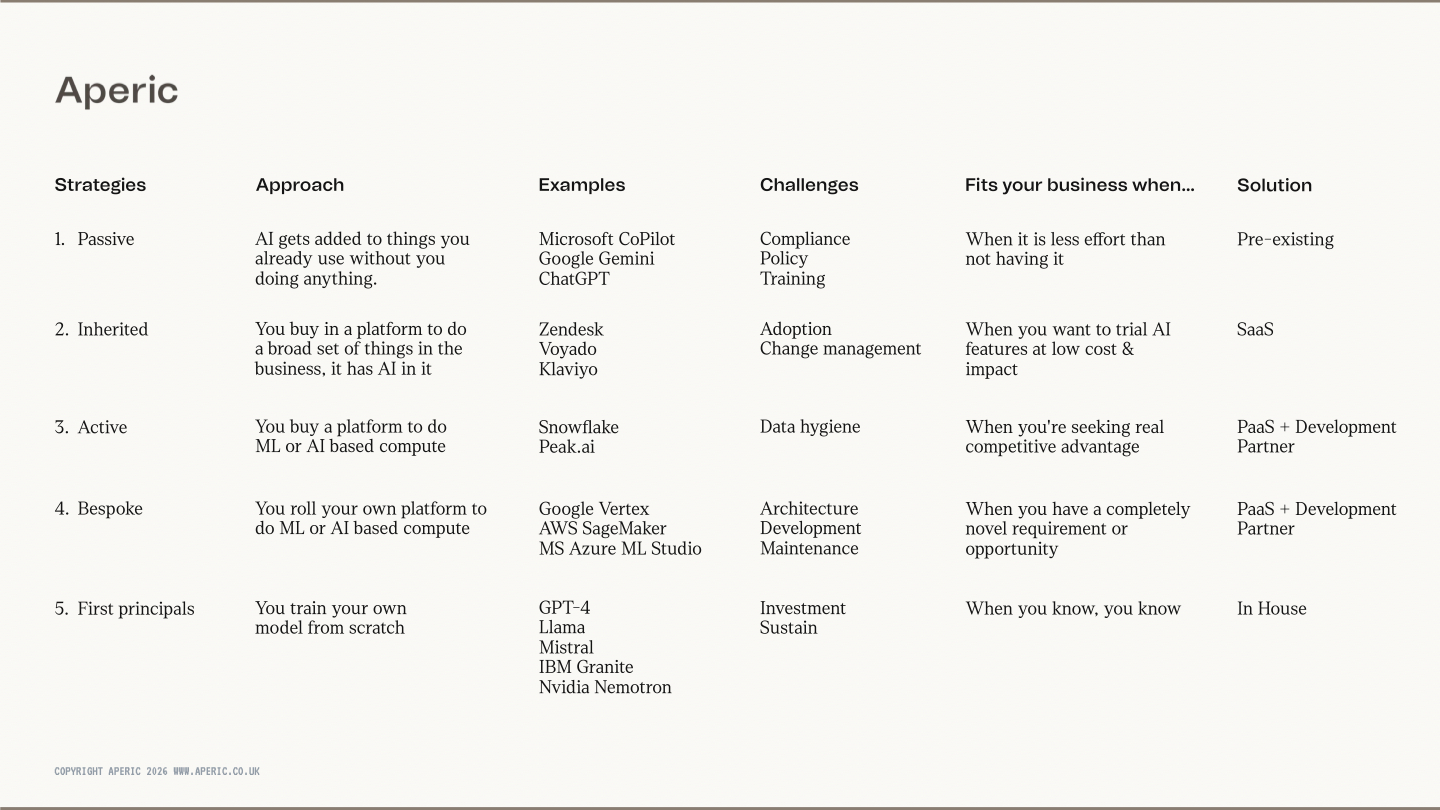
The AI revolution isn't coming; for most businesses, it’s already been installed. You are likely using AI today, whether you’ve defined a "strategy" for it or not:
Practical AI strategies at a glance
Why you can’t look away
Because AI is being integrated automatically, "doing nothing" is no longer a neutral stance—it’s a choice to let your software providers dictate your operational logic.
Everyone, from solo founders to enterprise leads, must take notice. Not because you need to build the next great model, but because you need to manage the tools that are already sitting on your desktop.
Strategy starts with awareness. If it’s already in your business, it’s time to decide how you’re going to use it.